 \n
Explore precision-engineered jewelry sets, custom pendant configurations, and anti-tarnish stackable lines built for global boutique distributors and high-volume e-commerce platforms.






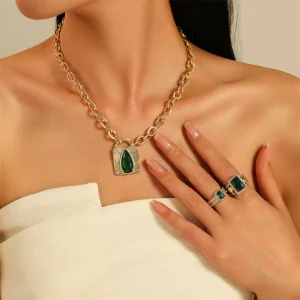
The global fine body jewelry market is undergoing a structural paradigm shift. Driven by surging consumer demand for hypoallergenic, tarnish-free, and skin-safe wearable adornments, the sector has evolved from high-turnover "fast fashion" accessories toward durable, semi-fine, and fine engineering standards.
According to recent industrial market intelligence, the global body jewelry and semi-fine jewelry segment is expanding at a Compound Annual Growth Rate (CAGR) of over 7.8%, exceeding $21.5 Billion globally. Modern procurement managers, retail brand buyers, and enterprise importers no longer evaluate supply chain partners based solely on initial unit piece price. Instead, competitive advantage is defined by metallurgical integrity (316L Surgical Steel, G23 Titanium, and lead/cadmium-free brass), vacuum Physical Vapor Deposition (PVD) durability, color-match precision across batch runs, and friction-free international regulatory clearance.
Securing market share in fine body jewelry requires moving past basic electroplating into advanced surface chemistry and structural metallurgy. China’s leading manufacturing facilities utilize state-of-the-art technological stack configurations:
Physical Vapor Deposition (PVD) utilizes titanium nitride or real 18K gold vaporized in a vacuum chamber. Unlike traditional liquid electroplating that chips or tarnishes within months, PVD creates an atomic bond layer with thicknesses ranging from 0.03 to 0.1 µm for standard lines, and up to 2.5 µm for heavy gold vermeil, guaranteeing sweatproof and waterproof longevity.
We utilize medical-grade ASTM F138 compliant 316L Stainless Steel, solid brass with zero added lead (<90ppm), and G23 Implant-Grade Titanium. Ultrasonic cleaning protocols remove drawing lubricants and residual compounds prior to coating, eliminating allergic skin reactions at the foundational level.
Integration of AI-driven camera inspection equipment verifies gem/cubic zirconia setting symmetry, stone prong tight tolerances, and surface scratch checks. Automated visual sorting ensures every production lot meets strict AQL 2.5 defect boundaries before packaging.
| Base Material Specification | Plating Method | Plating Thickness (µm) | Salt Spray Corrosion Test | Target Retail Positioning |
|---|---|---|---|---|
| 316L Surgical Stainless Steel | PVD Vacuum Ion Plating (14K/18K/24K Gold) | 0.03 µm – 0.08 µm | 72 Hours (Tarnish-Proof) | Waterproof DTC E-Commerce Brands |
| ECO-Friendly Brass (Cu-Zn Alloy) | Rack Electroplating + E-Coating (Anti-Tarnish) | 0.1 µm – 0.5 µm | 48 Hours Standard | Boutique Fashion Chains & Wholesale |
| 925 Sterling Silver | Heavy Gold Vermeil / Rhodium Flashing | 1.0 µm – 2.5 µm | 96 Hours Premium | Luxury Fine Jewelry Outlets |
| G23 Implant Titanium | Anodization & Micro-Arc Oxidation | N/A (Oxide Layer Color) | 168 Hours (Biocompatible) | Professional Piercing Studios & Medical Body Art |
Sourcing fine body jewelry requires adherence to regional compliance dynamics. A single product line manufactured for the North American market may fail European customs if chemical compositions or labeling standards do not strictly align with local legislation.
Key Requirements: California Proposition 65 compliance (Lead < 90 ppm, Cadmium < 300 ppm) and US FTC Jewelry Guides for karat gold weight labeling. DTC e-commerce channels require individual barcode (FBA ready) poly-bagging, anti-tarnish strips inside velvet pouches, and sweatproof performance validation for fitness-oriented jewelry lines.
Key Requirements: REACH Regulation Annex XVII (Items 27, 51, 52) and EN 1811:2011+A1:2015 Nickel Release testing (rate must be less than 0.5 µg/cm²/week for body-contact items, and less than 0.2 µg/cm²/week for post-assemblies intended for pierced ears). All items require full chemical documentation and CE/UKCA marking where integrated packaging electronics are involved.
Our integrated manufacturing operation in Yiwu, Zhejiang transforms design concepts into retail-ready merchandise via a transparent 5-stage engineering protocol.
-
Stage 1: Design Brief, CAD Modeling & Spectrometry Costing
Buyers submit reference sketches, tech packs, or physical samples. Our engineering team responds within 24 hours with 3D CAD renders, calculated alloy weights, and itemized unit pricing. Spectrometric material composition analysis is performed before mold production commences.
-
Stage 2: Rapid 3D Resin Prototyping & Master Mold Tooling
Using high-resolution resin 3D printing (0.025mm layer resolution), physical prototypes are created in 48 to 72 hours. Once tactile weight, clasp mechanics, and stone dimensions are confirmed, high-durability steel master molds are cut via CNC milling.
-
Stage 3: Precision Casting, Polishing & Ultrasonic De-greasing
Vacuum investment casting guarantees pore-free metallic surfaces. Cast parts undergo hand-finishing followed by automated 5-axis magnetic polishing. Submersible multi-frequency ultrasonic baths remove all polishing compounds prior to surface treatment.
-
Stage 4: PVD Ion Coating & XRF Thickness Verification
Items enter high-vacuum PVD chambers for gold, rose gold, silver, or black titanium plating. X-Ray Fluorescence (XRF) analyzers measure deposit thickness down to the nanometer across sample batches to verify adherence to brand spec sheets.
-
Stage 5: 3-Tier QC Inspection, Private Labeling & Export Logistics
Products undergo final inspection adhering to strict AQL 2.5 standards. Custom rigid gift boxes, branded care cards, barcode hangtags, and moisture-sealed shipping master cartons are prepared for seamless DDP, FOB, or EXW export clearance.
Managing international supply chains involves navigating lead time volatility, batch-to-batch color drift, and unpredictable import tariffs. We provide structural solution frameworks for corporate procurement officers:
Start new seasonal collections with minimum quantities as low as 50–100 pieces per design. Shared casting molds and standardized chain links allow multi-color (14K Gold, 18K Gold, Silver) assortments to share a single production run threshold.
We eliminate color variance across repeat orders. Physical spectrophotometric color standards (e.g., standard Hamilton Gold, European 18K Yellow Gold, Warm 14K Gold) are recorded on spectrophotometers and locked in your permanent buyer profile.
Eliminate secondary domestic packing costs. We handle custom debossed rigid boxes, recycled FSC-certified paper cards, anti-tarnish micro-fiber pouches, and Amazon FBA product labeling directly on our factory floor.
Discover high-demand medallion sets, 3-layer stackable chokers, wheat pattern necklaces, and luxury designer-grade components crafted for international distribution.
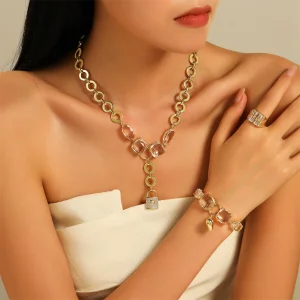
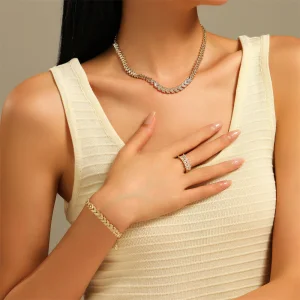



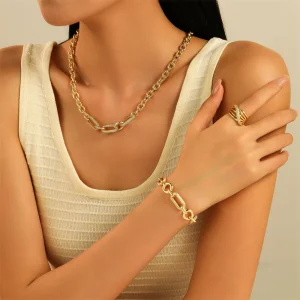
Clear, definitive answers to technical, logistical, and compliance questions asked by professional jewelry buyers prior to contract signing.