 \n
Featured Fine Jewelry & Solid Gold Collections
Precision-engineered export designs manufactured to strict EU REACH and US FTC karat purity standards.





1. Global Real Solid Gold Ecosystem & Market Dynamics
Analyzing structural shifts in karatage demand, raw material liquidity, and physical gold sourcing compliance.
The international fine jewelry sector is undergoing a profound structural recalibration. Modern enterprise procurement teams, luxury conglomerate buyers, and high-growth digital DTC brands are re-evaluating their global supply chains to balance intrinsic metallic value, physical durability, and micro-alloy engineering. Real solid gold jewelry—ranging across 10K (41.7% Au), 14K (58.5% Au), 18K (75.0% Au), and 24K (99.9% pure Au)—represents the cornerstone of enduring store-of-value consumer merchandise. Unlike fashion jewelry relying on base-metal substrates (brass or 316L stainless steel) with sacrificial electroplated layers, real solid gold possesses zero risk of subterranean oxidation, base-metal leaching, or coating degradation.
China has consolidated its position as the premier manufacturing powerhouse for real solid gold jewelry, synthesizing traditional craftsmanship with extreme-precision automated metallurgy. The global demand landscape requires nuanced regional customization: North American markets demand high-tensile 10K and 14K yellow, rose, and white gold engineered for daily wear resistance; European buyers prioritize nickel-free 14K and 18K alloys strictly compliant with REACH Annex XVII; while the Middle East and East Asian markets focus heavily on 18K, 22K, and 24K ultra-pure gold with high melt-value liquidity.
| Jewelry Metal Classification | Gold Content (Au %) | Density (g/cm³) | Vickers Hardness (HV) | Primary Global Demand Markets | Resale / Melt Value Integrity |
|---|---|---|---|---|---|
| 24K Solid Fine Gold (5G/Hard Gold) | 99.9% - 99.99% | 19.32 | 120 - 180 (Modified) | China, India, GCC Region, SE Asia | 100% Spot Melt Value |
| 18K Solid Gold (Au 750) | 75.0% | 15.20 - 15.90 | 150 - 210 | Europe, Middle East, Luxury Global Brands | High (75% Bullion Parity) |
| 14K Solid Gold (Au 585) | 58.5% | 12.90 - 14.60 | 160 - 240 | United States, Canada, Australia | Moderate-High (58.5% Parity) |
| 10K Solid Gold (Au 417) | 41.7% | 11.40 - 12.10 | 180 - 250 | US Commercial Retail, High-Durability Lines | Moderate (41.7% Parity) |
| Gold Vermeil / Heavy PVD (Non-Solid) | 0.05% - 2.5% (Surface) | Base Metal Dependent | Depends on Core Metal | Fast Fashion, Entry-Level E-Commerce | Zero Metal Recovability Value |
2. Industrial Infrastructure & China Factory Efficiency Superiority
How specialized manufacturing ecosystems in Guangzhou, Shenzhen, and Yiwu drive unprecedented yield rates, minimal metal loss, and micro-tolerance precision.
Advanced Induction Vacuum Casting
Utilizing inert argon atmosphere gas-flushing casting furnaces prevents oxygen entrapment, eliminating subsurface micro-porosity and guaranteeing structural density across complex 10K-18K gold geometries.
CAD/CAM & 3D Photopolymer Resin Matrices
Digital design workflows yield 5-micron dimensional tolerance. 3D printing directly to castable resin models eliminates manual carving defects, reducing sample development timelines from weeks to under 48 hours.
Closed-Loop Gold Recovery & Loss Control
Equipped with centralized suction filtration, chemical refining, and real-time scrap reclamation. Factory gold loss is capped below 0.15%, passing direct raw-material cost savings down to B2B buyers.
Industrial Cluster Synergies
China's dominance in fine gold jewelry manufacturing stems from hyper-specialized industrial clusters. Guangzhou (Panyu) serves as the global epicenter for intricate gemstone setting, micro-pave diamond mounting, and high-karat hand finishing, handling over 60% of the world's custom luxury OEM manufacturing. Shenzhen (Shuibei) houses the world's most concentrated gold trading ecosystem, offering real-time spot pricing, automated metallurgical testing, and continuous vacuum casting machinery. Concurrently, Yiwu excels in rapid-turnaround agile production, high-volume fine chain assembly, and streamlined export logistics.
This integrated ecosystem allows Chinese solid gold suppliers to maintain a distinct competitive edge: unrivaled scale, strict karat assay guarantee via fire assay and XRF techniques, and extremely short lead times. Where traditional Western workshops require 6 to 8 weeks for custom gold production, Chinese manufacturing hubs regularly execute full OEM production cycles within 12 to 18 business days.
3. Regional Application Scenarios & Global Procurement Profiles
Customizing alloy compositions, surface hallmarking, and mechanical specs to align with target destination regulations.
North America (US & CA)
Primary Karatage: 10K, 14K Solid Gold.
Consumer Application: "Dainty" everyday wear, stackable rings, personalized initial pendants, waterproof solid gold chains.
Compliance: US FTC Jewelry Guides, mandatory manufacturer hallmark + karat stamp (e.g., "14K").
European Union (EU & UK)
Primary Karatage: 14K (585) & 18K (750) Gold.
Consumer Application: Fine minimalist luxury, certified lab-grown diamond mountings, sustainable recycled gold lines.
Compliance: EN 1811 Nickel Release standard, REACH Annex XVII, Assay Office Sponsor Marks.
Middle East (GCC Region)
Primary Karatage: 18K, 21K, 22K Solid Gold.
Consumer Application: Heavy bridal suites, intricate filigree work, high-luster polished finishes, bullion-linked jewelry.
Compliance: Strict Dubai Central Laboratory (DCL) or equivalent physical melt assay verification.
Asia-Pacific (APAC)
Primary Karatage: 24K (999 Fine Gold) & 18K.
Consumer Application: 5G Hard Gold lightweight charms, investment bangles, heritage cultural motifs.
Compliance: National Precious Metals Standard GB 11887-2012 (Zero-addition purity rules).
4. Macro Trends Shaping Global Solid Gold Jewelry Manufacturing
Metallurgical breakthroughs redefine physical parameters, enabling ultra-lightweight structural strength and ESG compliance.
5G Hard Gold Metallurgical Technology
By introducing trace micro-alloying elements (such as cobalt or rare-earth refining agents) combined with electroforming, 5G gold achieves a Vickers hardness rating of 140–180 HV (over twice that of traditional 24K gold). This allows factories to manufacture 24K solid gold pieces with 40-50% less gold weight while retaining structural rigidity and resistance to bending.
Closed-Loop Recycled & Conflict-Free Sourcing
Institutional buyers increasingly enforce ESG auditability. Leading Chinese manufacturers now utilize 100% LBMA (London Bullion Market Association) certified recycled gold sourced from refined electronic scrap and audited secondary precious metals. This slashes carbon footprint profiles by up to 98% compared to primary mined gold, satisfying EU Corporate Sustainability Due Diligence Directives (CSDDD).
Lab-Grown Diamond (CVD/HPHT) Hybrid Mountings
The convergence of lab-grown diamonds with solid gold mountings has democratized accessible luxury. China's factories provide integrated OEM casting and setting workflows, mounting high-clarity (VS+) lab diamonds directly into 10K-18K gold settings using automated 4-axis CNC micro-setting machinery, drastically lowering per-unit production overhead.
5. B2B Procurement Protocol & Quality Risk Control Manual
How enterprise buyers protect margin integrity, verify karat purity, and mitigate bullion market volatility.
Step 1: Metallurgical Assay Verification (XRF & Fire Assay)
When procuring solid gold, relying solely on surface stamps is insufficient for audit compliance. Premier Chinese suppliers execute a dual-tier testing protocol:
- X-Ray Fluorescence (XRF) Spectrometry: Non-destructive instantaneous surface testing measuring metallic composition down to ±0.03% accuracy, verifying alloy homogeneity across batches.
- Fire Assay (Cupellation) Testing (ISO 11426 standard): The destructive gold standard method utilized for high-value production lots. Samples are melted with lead, cupelled to remove base metals, and nitric-acid parting measures exact fine gold content down to 0.1 parts per thousand.
Step 2: Real-Time Spot Hedging & Transparent Cost Modeling
Solid gold B2B transactions differ from fashion accessories due to fluctuating raw material costs based on London Bullion Market Association (LBMA) or Shanghai Gold Exchange (SGE) spot pricing. Reliable manufacturers utilize a transparent "Gold Spot Price + Labor/Manufacturing Fee (Loss Coefficient Included)" pricing matrix:
Total Unit Price = [ Net Weight (g) × (1 + Loss Factor %) × Gold Spot Price ($/g) × Karat Purity % ] + CNC/Casting Labor + Stone/Setting Fee
Step 3: Tooling Ownership, IP Protection, & Mold Vaulting
Enterprise procurement requires strict protection of custom CAD assets and physical rubber/steel master molds. Verified OEM suppliers sign legally binding Non-Disclosure Agreements (NDAs), store digital CAD files on air-gapped encrypted servers, and physically vault master molds with unique serial tracking, preventing unauthorized replication across secondary markets.
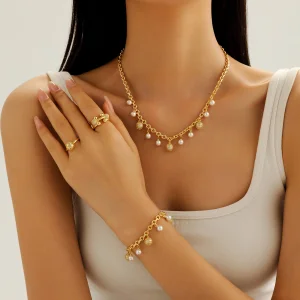
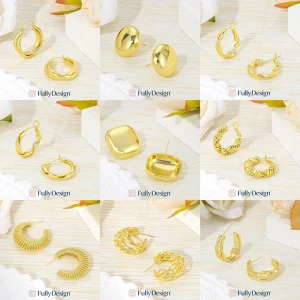
Wholesale Solid Gold & Fine Jewelry Configurations
Explore high-demand commercial styles engineered for international wholesale distribution.

Frequently Asked Questions for B2B Gold Jewelry Sourcing
Direct technical answers to common queries regarding MOQs, metallurgical assays, lead times, and custom ODM tooling.
What is the standard Minimum Order Quantity (MOQ) for custom real solid gold jewelry orders?
For custom OEM/ODM real solid gold jewelry (10K, 14K, 18K), our baseline production MOQ starts as low as 20 to 50 pieces per design, provided the gold casting batch weight threshold is met. For catalog designs with existing Master Rubber Molds, MOQs can be negotiated down to 5 to 10 pieces per SKU, facilitating low-risk inventory testing for premium brands.
How do you guarantee gold karat purity compliance for international import regulations?
Every production batch undergoes dual-stage assay testing. First, inline non-destructive X-Ray Fluorescence (XRF) analysis verifies alloy composition before assembly. Second, batch sample coupons undergo destructive Fire Assay (Cupellation) following ISO 11426 guidelines. We provide certified metallurgical test reports with every shipment and guarantee 100% compliance with US FTC Karat Stamping guidelines and European Assay Office standards.
What are the typical lead times for 3D sampling and bulk production?
Digital CAD renders are delivered within 24 to 48 hours. Upon CAD sign-off, high-precision photopolymer 3D wax resin prints and silver counter-samples are produced within 5 to 7 business days. Full-scale bulk casting, gem setting, and hand-polishing production runs require 12 to 18 business days depending on complexity and gemstone availability.
How is pricing locked in given real-time physical gold market price volatility?
Manufacturing labor, stone setting, and casting overhead costs are quoted as fixed rates per unit. The precious metal component is transparently calculated based on the live London Bullion Market Association (LBMA) or Shanghai Gold Exchange (SGE) spot gold price at the exact moment of formal purchase order execution and deposit receipt. Buyers can also provide their own fine gold grain (Au 999.9) via bonded metal account transfers.
Can you manufacture custom white gold or rose gold alloys that are nickel-free for EU REACH compliance?
Yes. All our solid rose and white gold formulations utilize non-allergenic palladium, silver, and copper master alloys. We strictly prohibit the use of nickel secondary hardeners in compliance with the EU REACH Annex XVII Directive and EN 1811 Nickel Release standards, ensuring zero skin irritation and 100% hypoallergenic compliance for European retail markets.