 \n
Featured Wholesale Jewelry Sets & Charms
Precision-machined, hypoallergenic, and compliant with international heavy-metal safety regulations.
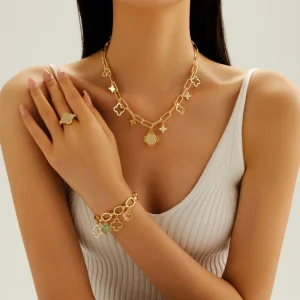
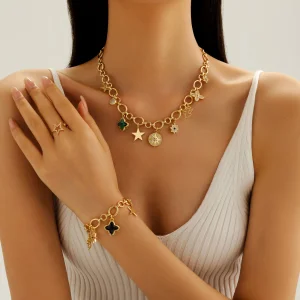
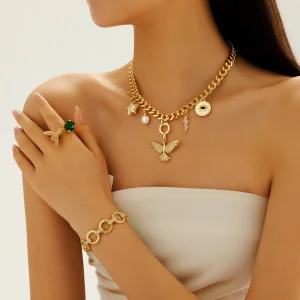
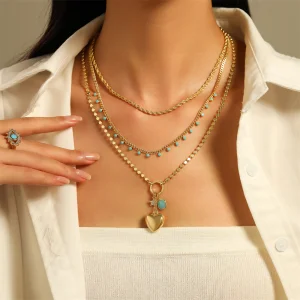
1. Global Landscape of the Wholesale Costume Jewelry Set Market
The global costume jewelry sector has evolved from low-cost, short-lifecycle fashion accessories into a sophisticated market driven by high-durability materials, eco-conscious metal processing, and rapid OEM/ODM design iteration. Valued at over USD 45 Billion globally, demand for complete costume jewelry sets—typically comprising co-ordinated layered necklaces, charm bracelets, drop earrings, and stackable rings—is outstripping single-piece procurements. B2B buyers, including boutique chains, department store concessionaires, and digital-native e-commerce brands, leverage synchronized sets to boost average order value (AOV) and customer retention.
Modern consumers demand aesthetic parity with fine jewelry (such as 14K/18K gold luster, natural stone inlays, and flawless micro-pave cubic zirconia) paired with the price accessibility of non-precious substrates. Consequently, wholesale buyers require manufacturing partners capable of balancing metallurgical longevity, strict chemical safety compliance, and agile production schedules.
2. Structural Advantages of Manufacturing in Chinese Industrial Clusters
China remains the undisputed epicenter of global fashion jewelry manufacturing, driven by dense industrial agglomerations primarily concentrated in Zhejiang (Yiwu) and Guangdong (Guangzhou, Dongguan, and Shanwei). These manufacturing ecosystems offer unique structural efficiencies that cannot be easily replicated by alternative sourcing hubs:
Vertical Supply Chain Integration
Within a 15-kilometer radius in Yiwu or Panyu, factories access raw alloy foundries, precision casting shops, gemstone cutting facilities, PVD vacuum plating units, and custom packaging suppliers. This proximity compresses component transit time to hours.
Rapid CAD & 3D Wax Molding
Utilizing high-resolution resin 3D printers, Chinese manufacturers convert buyer concept sketches or reference photos into physical silver/wax samples within 48 to 72 hours, reducing traditional sampling cycles by over 60%.
Economies of Scale & Material Yield
High-volume automated centrifugal casting machines and multi-chamber vacuum ion coaters ensure minimal raw material waste. Bulk purchasing of 316L steel, brass, and AAA CZ crystals guarantees cost leadership for wholesale distributors.
3. Metallurgical Engineering & Coating Specifications
Understanding substrate selection and surface finishing mechanics is critical for B2B procurement managers to avoid quality claims and regulatory recalls. Costume jewelry sets manufactured for Western markets must strictly comply with heavy metal thresholds under REACH Annex XVII (Items 23, 27, and 63) in Europe and California Proposition 65 / ASTM F2923 in North America.
| Base Material | Common Alloy Grade | Plating Method | Standard Thickness | Target Corrosion Resistance | Best Use Case Application |
|---|---|---|---|---|---|
| Stainless Steel | 316L / 304 Surgical Steel | PVD Ion Gold/Rhodium Plating | 0.03 – 0.10 µm (Titanium Nitride Base) | 48 Hours Salt-Spray (Non-Tarnish) | High-end Water-Resistant Everyday Wear |
| Eco-Friendly Brass | CuZn37 (Low Lead < 90 ppm) | Rack Electroplating + E-Coating | 0.05 – 0.25 µm (Real 14K/18K Gold) | 24 Hours Salt-Spray | Intricate Fashion Statement Sets / Bridal |
| Zinc Alloy | Zamak 3 / Zamak 5 | Barrel / Rack Plating | Flash Gold + Acrylic Lacquer | 12 Hours Salt-Spray | Budget Fast-Fashion Promotional Sets |
Technical Note on Chemical Safety Standards:
To pass European compliance, Nickel Release must fall below 0.5 µg/cm²/week for items intended for direct skin contact (EN 1811 standard). Total Lead (Pb) content must remain under 0.05% (500 ppm) and Cadmium (Cd) under 0.01% (100 ppm). Qualified Chinese factories utilize X-ray Fluorescence (XRF) analyzers onsite to verify raw material purity before casting.
4. Global Sourcing Demands & Buyer Persona Mapping
Sourcing requirements differ significantly based on the buyer's retail channel and target demographic. Direct-to-Consumer (DTC) brands prioritize product longevity and custom unboxing experiences, whereas volume importers prioritize price-per-unit metrics and fast shipping logistics.
E-Commerce & Amazon FBA Sellers
Primary Demands: Compact poly-bag packaging, individual FNSKU barcode labeling, low minimum order quantities (50-100 sets per SKU), waterproof non-tarnish guarantees, and high-resolution lifestyle photography rights.
Fashion Boutiques & Chain Retailers
Primary Demands: Custom logo laser engraving, branded velvet pouches or rigid display boxes, curated seasonal design drops (Spring/Summer vs. Fall/Holiday), and EDI invoice integration.
Wholesale Distributors & Importers
Primary Demands: Tiered bulk pricing, Master Carton optimization for sea/air freight, OEM custom tooling rights, factory audit documentation (BSCI, ISO9001), and flexible payment terms (T/T, L/C).
5. Regional Styling Trends & Application Scenarios
A successful wholesale procurement strategy must align factory production lines with regional aesthetic preferences:
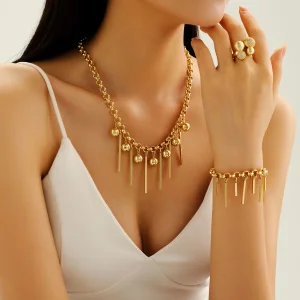
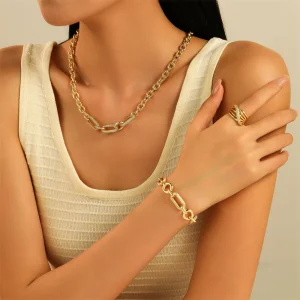
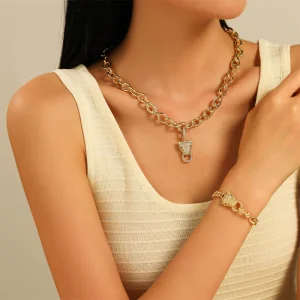
North America: High demand for chunky paperclip chain layering sets, evil-eye charm pendants, starburst motifs, and textured gold ball tassels. The dominant metal preference is warm 14K yellow gold PVD over stainless steel.
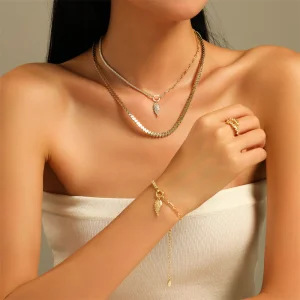
Western Europe: Strong preference for delicate, minimalist aesthetics—thin pendant chains, geometric lockets, and subtle leaf motifs. Materials favor eco-friendly recycled metals, pale 18K champagne gold finishes, and nickel-free compliance certificates.
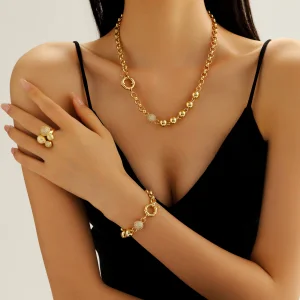
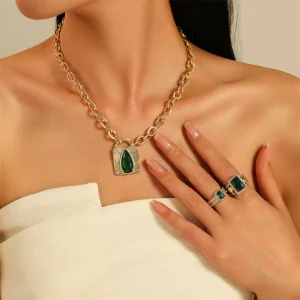
Latin America & Middle East: High appetite for bold, dramatic statement jewelry sets. Heavy multi-layer rolo chains, turquoise bead accents, synthetic agate inlays, and high-luster 24K gold tone finishes dominate retail sales.
Custom & Vintage Wholesale Collections
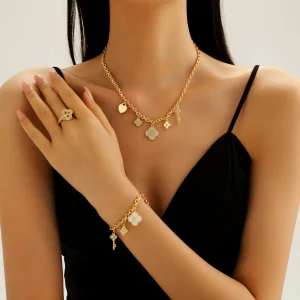
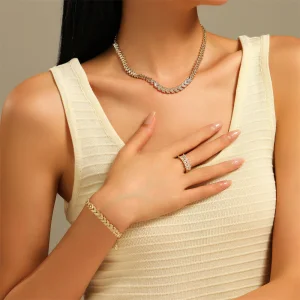
Explore specialized OEM/ODM options including agate inlays, vintage rolo chains, and customizable lockets.

6. Factory Standard Operating Procedure (SOP): From RFQ to Shipment
To ensure consistent output across 10,000+ unit batch runs, direct-manufacturing operations adhere to a rigorous 6-phase Quality Assurance workflow:
Technical Spec Analysis
Evaluation of buyer 2D drawings, vector artwork, or sample physical renders. Engineers establish weight tolerances, wall thickness minimums (0.8mm for hollow items), and pin/clasp load specs.
Master Mold & Prototype
CAD file generation followed by high-resolution resin wax printing, rubber mold vulcanization, and master silver sample casting. Prototyping complete in 7 days.
Precision Casting & Stamping
Vacuum pressure casting for brass/silver alloys; hydraulic stamping for paperclip chain links; high-precision CNC machining for 316L stainless steel components.
Automated & Hand Polishing
Multi-stage magnetic tumbling to remove casting burrs, followed by manual mirror polishing on cotton wheels to achieve surface roughness below Ra 0.02 µm.
PVD Ion Vacuum Plating
Deposition of real 14K/18K gold inside a high-vacuum titanium ion chamber. Real-time XRF measurements verify layer depth across batch samples.
AQL 2.5 Final Inspection
Visual inspection for pitting, stone alignment checks under 10x magnification, 5kg chain pull testing, anti-tarnish salt-spray verification, and packaging audit.
7. Industry 4.0 Trends Reshaping Jewelry Manufacturing
The costume jewelry factory of 2026 is rapidly integrating smart automation to combat rising labor costs and shorten production lead times:
- AI-Assisted Trend Forecasting: Machine learning algorithms scan global social media visual feeds and search engine queries to predict trending charms (e.g., evil eye, clover motifs, paperclip structures) 60 days before peak retail demand.
- Closed-Loop Zero-Discharge Plating: Implementation of advanced membrane filtration and electro-coagulation systems enables modern plating facilities to recycle 98% of process water while fully recovering precious metal residues.
- Laser Micro-Welding Automation: Robotic fiber laser welders replace manual soldering for chain link joints and charm attachment, yielding 300% higher joint tensile strength and invisible seam lines.
Frequently Asked Questions (FAQ)
Essential technical and procurement guidance for international jewelry buyers and sourcing agents.
What is the typical Minimum Order Quantity (MOQ) for custom jewelry sets?
Our standard production MOQ starts at 50 to 100 pieces per design for existing catalog styles. For fully custom OEM designs requiring new master mold creation, MOQ is typically 200 to 300 sets per style. Assorted color variants (e.g., Gold, Rose Gold, Silver) can share base mold quantities.
What is the difference between standard electroplating and PVD vacuum coating?
Traditional electroplating coats metal via chemical baths, producing a thin layer prone to wear and oxidation over time. PVD (Physical Vapor Deposition) takes place in a high-vacuum chamber where titanium nitride and real gold are atomized and bonded directly to stainless steel at a molecular level. PVD coating is 10 times more durable, highly tarnish-resistant, and 100% eco-friendly.
How long does sample development and mass production take?
CAD file creation takes 24–48 hours. Physical 3D resin or metal prototypes are completed within 7 to 10 business days. Once mass production samples are approved, standard batch manufacturing takes 15 to 25 calendar days depending on design complexity and plating specs.
Can your products pass REACH, California Prop 65, and Nickel release tests?
Yes. All raw materials (316L steel, lead-free brass, zinc alloy) and plating chemistries are formulated to pass EN 1811 (nickel release), REACH Annex XVII, and California Proposition 65 limits for Lead (<90ppm) and Cadmium (<75ppm). Official SGS, BV, or Intertek laboratory reports can be provided upon request.
Do you offer custom branded packaging and FBA barcoding services?
Yes. We provide end-to-end private label solutions including custom-printed rigid gift boxes, velvet pouches, logo foil-stamping, care cards, barcode sticker generation, and individual poly-bagging compliant with Amazon FBA warehouse requirements.
How do you ensure color consistency between initial samples and mass orders?
We utilize digital spectrophotometers and X-ray Fluorescence (XRF) analyzers to record exact Lab color space coordinates and plating thickness metrics for approved counter-samples. Master color chips are archived in vacuum-sealed environments for exact matching on repeat orders years later.
What shipping terms and international logistics options are supported?
We support standard commercial Incoterms including EXW, FOB (Ningbo/Shanghai/Guangzhou), CIF, and DDP (Delivered Duty Paid) via express air courier (DHL, FedEx, UPS), air freight, or ocean freight straight to your warehouse or fulfillment center.