 \n
High-Precision OEM/ODM Fancy Jewellery Showcase
Explore our primary manufacturing catalog engineered for global importers, online retail chains, and luxury brand distributors. Each piece utilizes advanced PVD ion plating and anti-tarnish micro-sealants.
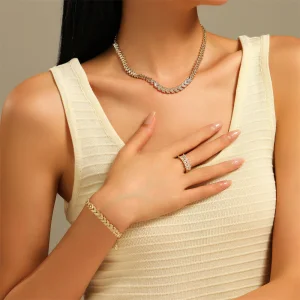



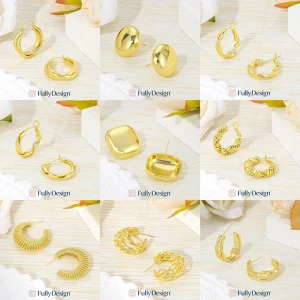


Global Macro Commercial Overview & Supply Chain Dynamics
Analyzing the structural shift in fancy jewellery manufacturing, procurement shifts toward eco-compliant PVD vacuum deposition, and global consumer demand trends.
The global fancy jewellery ecosystem is undergoing a profound paradigm shift. Historically categorized as low-cost costume accessories, high-tier fancy jewellery has bridged the structural gap between fast-fashion ornaments and fine gold/platinum jewellery. Modern B2B buyers—ranging from high-street fashion conglomerates and boutique chains to fast-growing direct-to-consumer (D2C) e-commerce brands—now demand fine-jewellery tactile aesthetics, extreme tarnish resistance, and total regulatory compliance without the exorbitant raw material overhead of solid precious metals.
China continues to anchor the global supply chain, with advanced clusters in Yiwu and Guangdong generating over 70% of world export volumes. However, the competitive benchmark for a modern wholesale fancy jewellery manufacturer & factory has evolved. Low-cost labor is no longer a sustainable competitive moat. Today's market leadership is defined by metallurgical innovation, automated vacuum deposition technologies, CAD/CAM rapid prototyping, and rigorous chemical safety protocols (REACH, Prop 65, RoHS). Professional importers must navigate complex geopolitical compliance, strict environmental regulations on electroplating wastewater, and rising consumer expectations for hypoallergenic daily-wear durability.
Strategic Procurement Insight for Commercial Buyers
To maintain brand equity and prevent high return rates, enterprise procurement teams are pivoting from traditional wet electroplating to Physical Vapor Deposition (PVD) titanium/steel coatings. Factories offering integrated OEM/ODM capabilities under one roof eliminate middleman markups, shorten product development cycles from months to under 10 days, and guarantee lot-to-lot color uniformity.
Material Engineering, Substrates, and Plating Science
An in-depth breakdown of base alloy selection, micron-level plating deposition, and advanced anti-tarnish protective sealing engineered for long-term wear.
316L Surgical Stainless Steel
Formulated with high nickel-chromium-molybdenum content, 316L stainless steel delivers superior corrosion resistance, structural rigidity, and zero skin reactivity. Ideal for waterproof fancy jewellery collections requiring long-lasting PVD gold integration.
Eco-Friendly Brass & Zinc Alloys
Refined lead-free and cadmium-free brass alloys engineered specifically for intricate lost-wax precision casting. Provides exceptional ductility for detailed stone setting, high-polish relief carving, and ornate vintage-style fancy jewellery sets.
PVD Vacuum Ion Plating Technology
Physical Vapor Deposition bombards Real 18K/14K Gold target material into atomic vapor inside a vacuum chamber. This creates a high-density, molecularly fused coating (0.03µm – 0.1µm+) up to 10 times more durable than conventional electroplating.
Technical Standard Comparison Matrix
| Manufacturing Property | Standard Electroplating | Heavy Gold Flash Plating | PVD Vacuum Ion Coating (Factory Benchmark) |
|---|---|---|---|
| Plating Thickness Range | 0.01 – 0.02 Microns | 0.1 – 0.25 Microns | 0.03 – 0.5+ Microns (PVD) / Up to 2.5µm (Micron Gold) |
| Color Retention Period | 1 – 3 Months (Tarnishes easily) | 6 – 12 Months | 24 – 36+ Months (Sweat & Water Proof) |
| Substrate Compatibility | Copper, Zinc Alloy | Brass, 925 Sterling Silver | 316L Stainless Steel, Titanium, Brass |
| Abrasion & Salt Spray Test | Fails < 8 Hours Salt Spray | Passes 12–24 Hours | Passes 48–96+ Hours Artificial Sweat & Corrosion |
| Environmental Impact | High Chemical Waste | Moderate Chemical Waste | Zero Hazardous Effluent (Eco-Friendly Process) |
Technological Roadmap & Industry Trends (2025–2030)
How generative AI design, automated precision tooling, and green chemistry are reshaping enterprise fancy jewellery manufacturing.
1. Generative AI & Rapid 3D CAD Prototyping
Integrating generative AI algorithms into industrial CAD workflows enables rapid prototyping of complex geometric fancy jewellery sets. What previously required weeks of manual hand wax sculpting is now rendered, structural-stress-tested, and 3D printed in high-resolution resin within 24 to 48 hours.
2. Automated Robotic Polishing & Fiber Laser CNC
Human polishing variability leads to uneven surface reflectivity. Modern manufacturing plants employ multi-axis robotic arms for mirror polishing, coupled with high-precision fiber lasers for micro-engraving brand logos, custom hallmarks, and complex filigree textures with sub-micron accuracy.
3. Closed-Loop Green Chemistry & Zero Discharge
Strict environmental enforcement globally requires production facilities to adopt closed-loop water purification and metal recycling systems. Green electroplating processes substitute toxic cyanides with advanced acid-citrate and gold-thiosulfate formulations without compromising plating brilliancy.
4. Lab-Grown Gemstones & Synthetic CZ Integration
Fancy jewellery increasingly incorporates high-refractive-index 5A Cubic Zirconia (CZ), synthetic moissanite, and lab-created gemstones. Precision micro-pave hand-setting and wax-casting stone inlay ensure maximum light dispersion while preventing stone loss during wear.
5. Nano-Ceramic E-Coating Sealing
Post-plating application of clear nano-ceramic electrophoresis (E-coating) adds an invisible, ultra-thin barrier coat (0.5–2.0 microns). This layer drastically reduces friction wear, prevents oxidation from perfume or seawater, and preserves gold brilliance under harsh retail lighting.
6. Smart Traceability & RFID Batch Tracking
Enterprise B2B buyers require transparent supply chains. Incorporating batch-level RFID tracking and digital passports ensures complete raw material traceability, verified non-conflict stone origin, and audit-ready compliance records for enterprise importers.
Localization & Regional Regulatory Compliance Framework
Navigating regional safety norms, heavy metal limitations, and customs verification to guarantee frictionless clearance across major consumer jurisdictions.
European Union (EU REACH Regulation)
Jewellery imported into the EU must strictly adhere to REACH Annex XVII standards. Key legal limits include Nickel Release Rates below 0.5 µg/cm²/week (EN 1811 test method), total Lead content below 0.05% (500 ppm), and Cadmium below 0.01% (100 ppm). Non-compliant batches face immediate seizure at customs and total recall.
United States (California Prop 65 & CPSC)
US imports are governed by Consumer Product Safety Commission (CPSC) standards and California Proposition 65 settlement limits. Fancy jewellery targeting children or adults requires rigorous lab testing for total Lead (under 90 ppm for children's items) and accessible Cadmium, supported by formal Certificates of Conformity (CPC).
Middle East & GCC Market Standards
The Gulf Cooperation Council (GCC) market emphasizes heavy, opulent aesthetic styling—such as 21K/22K yellow gold plating tones—combined with robust base structures. Plating specs must withstand ambient temperatures exceeding 40°C and high humidity without color degradation or blistering.
Japan & APAC High-Precision Requirements
Japanese and Asia-Pacific luxury buyers mandate pristine surface finishes, zero micro-scratches, smooth edge chamfering, and refined delicate scale work. Product inspections in these regions demand 100% optical magnification checks rather than standard AQL sampling.
Factory Quality Assurance Protocols: XRF Spectrometry Testing
Our manufacturing lines utilize in-house X-Ray Fluorescence (XRF) alloy analyzers to conduct non-destructive testing on every batch. Buyers receive verified spectral analysis reports certifying exact gold karat deposition, nickel-free barrier layers, and compliance with target buyer market standards prior to shipment.
The Enterprise OEM/ODM Manufacturing Process Flow
From initial tech pack analysis to final containerization: how our factory executes complex B2B production runs with 99.5% pass rates.
Technical Brief & Cost Optimization
Client submits a sketch, reference photo, physical sample, or CAD model. Our engineering team reviews metal volume, stone tolerances, and plating specs, delivering a line-by-line commercial quotation within 24 hours.
3D CAD Modeling & Prototyping
In-house CAD artists construct parametric 3D models. High-resolution resin prototypes are printed in 48 hours for physical evaluation of weight, ergonomic fit, clasp action, and stone mounting safety before master tooling.
Precision Tooling & Investment Casting
Steel master molds are machined via CNC. Rubber molds generate wax patterns for vacuum investment casting (lost-wax process) or high-pressure zinc injection, producing clean, porosity-free base metal blanks.
Multi-Stage Polishing & Gem Setting
Castings undergo automated deburring, magnetic polishing, and multi-tier hand mirror finishing. Master setters install Cubic Zirconia or crystal accents utilizing pave, prong, or bezel micro-setting techniques.
Vacuum PVD / Electroplating Deposition
Pieces are ultrasonically degreased, chemically cleaned, and loaded into PVD vacuum reactors or rack-plating baths. Multi-layer coatings (Nickel-free copper barrier + Real Gold + E-coating seal) are applied with precise micron controls.
AQL 1.5/2.5 QC & Private Label Packaging
Final inspection verified against ISO AQL guidelines: tensile clasp testing, cross-hatch plating adhesion checks, XRF thickness verification, custom gift box packing, barcode labeling, and FBA shipment prep.
B2B Manufacturing Solutions by Commercial Channel
Tailored manufacturing pipelines aligned with your specific business model, margin structure, and operational velocity.
Fast-Fashion & E-Commerce Brands
Engineered for viral TikTok/Instagram and Amazon brands requiring trend responsiveness. Low MOQs (50–100 pcs/style), rapid 7-day sampling, high-turnover inventory replenishment, and direct FBA prep with custom branded polybags or velvet pouches.
Boutique Chains & Department Stores
Tailored for physical brick-and-mortar retailers needing elevated perceived value. Premium 316L stainless steel or heavy brass construction, custom jewelry display cards, anti-tarnish tissue wrapping, and full EU/US chemical safety compliance dossiers.
High-Volume Wholesale Distributors
Designed for enterprise importers requiring bulk container volumes. Tiered pricing structures, dedicated factory production lines, customized master carton packing for long-haul maritime transport, and strict color consistency batch guarantees.
Trending Wholesale Fancy Jewellery Lineup
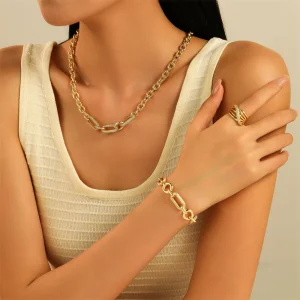
Discover our best-selling statement sets, multi-charm necklaces, and designer-inspired earrings crafted with high-spec gold finish coatings.
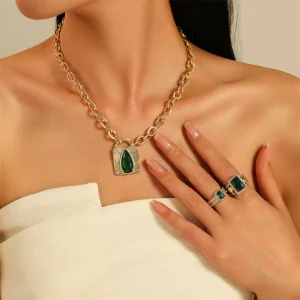


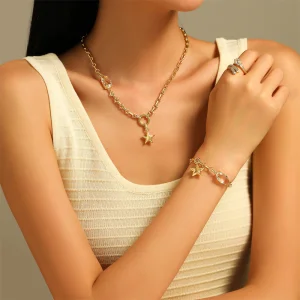

B2B Buyer Knowledge Base & Procurement Insights
Detailed technical answers to common queries regarding minimum order quantities, factory certifications, plating warranties, custom tooling, and customs clearing.
What is the baseline Minimum Order Quantity (MOQ) for custom fancy jewellery manufacturing?
Our standard factory MOQ starts at 50 to 100 pieces per design for items utilizing existing alloy molds and stocked gemstone dimensions. For completely custom OEM projects requiring new master steel tooling or unique custom die casting, the MOQ is typically 200 to 300 pieces per style. However, buyers can split color variations (e.g., 18K Yellow Gold PVD, Rose Gold, Rhodium/Silver) within a single production run to fulfill overall batch thresholds efficiently.
How does PVD vacuum plating differ from traditional electroplating in durability?
Physical Vapor Deposition (PVD) is conducted inside high-vacuum plasma chambers where target gold titanium atoms are vaporized and embedded directly into the substrate surface (such as 316L stainless steel). This creates an atomic bond that is significantly harder and more scratch-resistant than liquid chemical electroplating. Standard electroplating yields a surface layer prone to flaking or oxidative tarnishing within 3 to 6 months of wear. PVD vacuum gold plating retains its tone for 2 to 3+ years of daily wear, even when exposed to water, sweat, lotions, and ambient humidity.
What regulatory chemical compliance test reports can the factory provide?
We provide full laboratory test certifications for major international markets, including EU REACH Annex XVII (EN 1811 Nickel Release, Lead and Cadmium restrictions), US California Proposition 65 compliance, ASTM F2923 (Children's Jewelry Safety), and CPSC Lead standards. Each bulk order can be accompanied by factory-issued XRF Spectrometry plating thickness reports or third-party laboratory verification through SGS, Bureau Veritas (BV), or TÜV Rheinland upon buyer request.
What are the lead times for 3D sampling and bulk mass production?
Standard lead times are structured as follows:
• 3D CAD Modeling & Digital Renderings: 24 to 48 hours.
• Physical Resin Prototyping & Sample Finishing: 7 to 10 working days.
• New Master Mold Tooling: 12 to 15 calendar days.
• Bulk Factory Mass Production: 15 to 25 working days depending on order quantity, stone setting complexity, and packaging requirements. Expedited production slots are available for strategic enterprise partners.
Can you precisely match competitor physical samples or specific retail gold color tones?
Yes. Our laboratory uses spectrophotometers and XRF analytical equipment to match physical counter-samples sent to our facility. Whether your target brand standard calls for Hamilton 14K Light Champagne Gold, 18K Rich Yellow Gold, Vintage Antique Bronze, or Ultra-White Rhodium, we formulate exact target plating recipes. Once a color profile is approved by the client, master spectral signatures are archived in our database to ensure 100% color repeatability across future reorders.
What quality control inspection standards are implemented prior to shipping?
Every production batch passes through three dedicated QC gates based on ISO AQL 1.5 / 2.5 standards:
1. Raw Material & Casting Gate: XRF alloy composition verification and surface porosity checks.
2. In-Line Setting & Plating Gate: 24-hour artificial sweat immersion, salt-spray corrosion chamber testing, cross-hatch plating adhesion tests, and stone pull-force testing.
3. Final Pre-Shipment Gate: 100% visual magnification check for scratches, clasp spring tension verification, weight measurement, and box barcode scanning. Complete photo and video inspection dossiers are provided to buyers prior to carton sealing.
Do you offer custom private-label branding, packaging, and FBA fulfillment services?
Absolutely. We offer complete turn-key private label branding. This includes laser engraving logos onto pendants, tags, and clasps; custom debossed jewelry boxes, velvet pouches, care instruction cards, and hang tags; as well as item-level EAN/UPC barcode application. For e-commerce brands, we provide direct Amazon FBA fulfillment preparation—including carton packing, palletization, and compliant shipping labels—enabling goods to move seamlessly from our floor to fulfillment centers globally.