 \n
Featured Wholesale Gorgeous Jewellery Lineup
Direct-from-factory catalog items engineered for high-durability plating and international compliance.

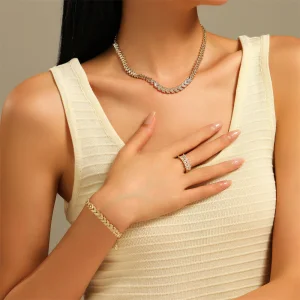
1. Global Trends in Gorgeous & Fine Fashion Jewellery Supply Chains
The global wholesale fashion jewellery landscape is undergoing a structural transformation driven by shifts in consumer preferences, technological integration, and stringent regulatory demands. Brand owners, retail sourcing directors, and enterprise buyers no longer evaluate a wholesale gorgeous jewellery supplier & factories merely on initial unit pricing. Modern procurement models require high structural integrity, verifiable material science, automated design workflows, and environmental transparency.
As fast-fashion cycles shorten and e-commerce platforms (such as Shopify, Amazon FBA, and regional omnichannel boutiques) require rapid inventory turns, manufacturers must pivot from traditional analog casting to advanced digital manufacturing ecosystems. To maintain a competitive edge, wholesale suppliers are integrating AI-driven predictive modeling, zero-discharge vacuum plating technology, and traceable raw material networks.
AI-Assisted CAD & Rapid Prototyping
Iterative jewelry prototyping has evolved from weeks to days. By utilizing generative AI CAD modeling paired with high-resolution resin 3D printing, manufacturers can convert trending conceptual sketches into physical master models within 48 to 72 hours, drastically reducing time-to-market for private-label collections.
Sustainable PVD & Eco-Alloys
Traditional wet cyanide electroplating is rapidly being phased out by tier-one global markets in favor of Physical Vapor Deposition (PVD) vacuum coating. Utilizing eco-friendly 316L surgical stainless steel and lead-free brass alloys, PVD technology offers ten-fold corrosion resistance while emitting zero chemical wastewater.
Modular MOQs & Agile Supply Chains
High-volume minimum order quantities (MOQs) are yielding to flexible, modular batch manufacturing. Enterprise buyers are opting for low initial test orders (50–100 pieces per SKU) with automated reorder triggers tied directly to POS data, mitigating inventory holding risks while maintaining bulk volume pricing tiers.
2. Global Enterprise Sourcing Intent & Buying Criteria
When enterprise procurement teams search for a wholesale gorgeous jewellery supplier & factory direct partner, their query intent spans complex parameters far beyond product aesthetics. Based on international buyer surveys, purchasing decisions prioritize long-term tarnish resistance, non-allergenic base metals, precise color-matching metrics (e.g., matching standard 18K real gold hues), and structural durability under daily wear.
| Buyer Segment | Primary Technical Criteria | Key Compliance Requirement | Preferred Logistics Framework |
|---|---|---|---|
| Luxury Fashion Brands | Heavy Gold PVD (>0.1 μm), Hand-set CZ / Natural Agate, Micro-polishing | REACH Annex XVII, EN 1811 (Nickel-free) | DDP Air Freight, Custom Luxury Gift Packaging |
| E-commerce & D2C Chains | Tarnish-proof 316L Stainless Steel, Low-weight ergonomically hollowed designs | California Prop 65 (Lead & Cadmium free) | FBA-Compliant Barcode & Individual Polybagging |
| Wholesale Importers | Competitive Unit Costing, Standardized 14K/18K Yellow/Rose Plating, High OT-Clasp Tensile Strength | General Certificate of Conformity (GCC), XRF Inspection Reports | FOB / CIF Container Sea Freight & Consolidated Cargo |
| Boutique Retail Networks | Unique Modular Charms, Vintage Hand-brushed Finishes, Matching Necklace/Bracelet Sets | ASTM F2923 Consumer Safety Standard | Turnkey Private-Label Display Cards & Boxes |
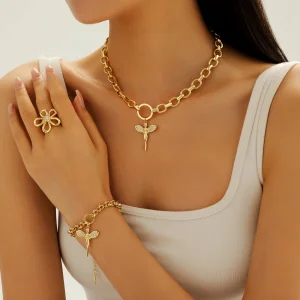
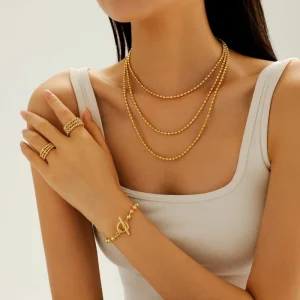
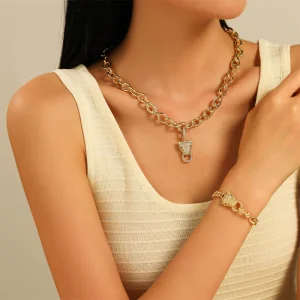
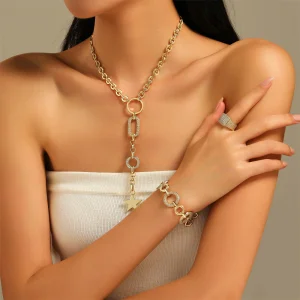
To successfully serve these diverse market segments, modern factories must operate robust Quality Management Systems (QMS) aligned with ISO 9001 standards. Every batch of chunky link gold chains, stackable collarbone necklaces, or intricate clover jewelry sets must undergo rigorous chemical and mechanical stress testing prior to export clearance.
3. Macro Manufacturing Solutions & Technical Specifications
Metallurgical Base Metal Selection
The manufacturing process begins with strict raw material verification. Suppliers utilize high-grade 316L surgical stainless steel or refined environmental brass. Stainless steel offers inherent rust resistance, structural rigidity for chunky link designs, and superior adhesion for PVD coatings. Environmental brass provides exceptional malleability for detailed filigree, fairy wing motifs, and vintage OT clasps.
Advanced PVD Deposition & XRF Testing
Surface treatment is performed inside multi-chamber titanium vacuum PVD systems. Real 18K gold or platinum target materials are vaporized into plasma, depositing nano-layers ranging from 0.03 μm for budget fashion lines to 0.1 μm+ for premium heavy-plated luxury jewelry. Non-destructive X-ray Fluorescence (XRF) spectrometry is conducted on every production batch to verify exact plating thickness and gold purity.
Surface Polishing Protocols
Multi-stage automated vibration tumbling combined with hand-buffing achieves a mirror-finish surface (roughness index Ra < 0.02 μm). This eliminates micro-porosity, ensuring maximum corrosion protection and a sleek tactile feel against the collarbone.
Stone Setting & Agate Assembly
Utilizing 4-prong claw settings and bezel mountings rather than simple adhesive gluing. High-grade AAA Cubic Zirconia and natural green agate stones are mechanically secured to withstand impact, thermal expansion, and daily friction.
Accelerated Salt-Spray Testing
Finished items undergo standardized 24-to-48 hour neutral salt-spray chamber testing (NSS ASTM B117 standard), simulating up to 2 years of real-world exposure to sweat and environmental moisture without oxidation.
4. Localization Support, Chemical Compliance & QA Protocols
Exporting fashion accessories globally requires navigating a patchwork of regional chemical safety regulations and customs enforcement protocols. Partnering with a certified China wholesale jewellery factory guarantees that incoming shipments pass regional port authorities without detention or costly product recalls.
European Union (REACH)
Full adherence to REACH Annex XVII. Strict nickel release limits tested per EN 1811 (<0.5 µg/cm²/week for wearable parts and <0.2 µg/cm²/week for post assemblies), along with total Lead (<0.05%) and Cadmium (<0.01%) compliance certified by SGS or Bureau Veritas.
United States (Prop 65)
Full compliance with California Proposition 65 settlement limits and ASTM F2923 standard specification for consumer product safety of children's and adult jewelry. Materials are verified non-hazardous for broad distribution across all 50 states.
AQL 2.5 Quality Inspection
Implementing strict Acceptable Quality Limit (AQL 2.5/4.0) sampling protocols prior to sealing cartons. Independent QC inspectors verify clasp tension, chain link alignment, surface finish uniformity, and barcode legibility before dispatch.
5. Technological Roadmap & Future Outlook (2025–2030)
The next decade of fashion jewelry manufacturing will be defined by smart digitalization, closed-loop material recycling, and digital-twin supply chain integration. As global enterprise buyers seek greater transparency, premier manufacturing hubs are investing heavily in automated production tracking and eco-engineering.
1. Digital Twin Sampling & Virtual Fitting
By leveraging 3D digital twin rendering engines, international buyers can visually inspect photorealistic jewelry prototypes under varying lighting conditions and body dimensions before physical tooling begins. This eliminates 90% of sample shipping latency and cuts master mold iteration costs significantly.
2. Automated Fiber Laser Engraving & Serialization
High-precision fiber laser systems allow dynamic micro-engraving of custom brand logos, serial numbers, and batch QR codes directly onto clasps and charm tags. This enhances brand protection against counterfeiters while simplifying inventory control for large-scale enterprise retailers.
3. Anti-Tarnish Nano-Clear Coating Innovation
Emerging nano-composite protective films applied via atomic layer deposition (ALD) create an invisible, hydrophobic barrier over gold plating. This breakthrough technology doubles resistance to sweat, perfume, and salt water without altering the metallic luster or skin-contact safety profile.
4. Closed-Loop Recycled Metal Sourcing
To align with global ESG (Environmental, Social, and Governance) requirements, advanced factories are integrating certified 100% recycled brass and recycled 316L steel into raw material feedstocks, reducing carbon footprint metrics for international retail partners.
6. Frequently Asked Questions (FAQ) for Enterprise Buyers
What is the typical minimum order quantity (MOQ) for custom OEM/ODM jewelry orders?
Our standard manufacturing MOQ begins at 50 to 100 pieces per design for catalog styles. For completely custom designs requiring original tooling and custom molds, the typical entry MOQ is 200 pieces per style. Mixed color variations (e.g., gold, rose gold, silver) or size assortments can often share a consolidated base quantity to lower inventory testing costs.
How do you ensure plating color consistency and tarnish resistance across different production batches?
Color consistency is achieved through computerized PVD vacuum chamber control parameters and strict target material specifications. Every batch is calibrated against physical golden master samples using X-Ray Fluorescence (XRF) colorimeters. Furthermore, our anti-tarnish protective sealing process passes 24-to-48 hour salt spray tests, guaranteeing extended shelf life and wearability.
What documentation and chemical test reports are provided with bulk export orders?
Every shipment is accompanied by internal batch inspection certificates covering material composition, XRF plating thickness readings, and AQL 2.5 visual reports. Upon request prior to mass production, we coordinate third-party testing via SGS, Intertek, or TÜV Rheinland to issue official REACH, EN 1811, and California Proposition 65 compliance certificates.
What is the turnaround time from initial concept sketch to mass production delivery?
Initial CAD designs are delivered within 24–48 hours. Physical 3D resin or metallic master samples take approximately 7 to 10 working days (or 12 to 15 days if complex mold casting is required). Once samples are approved, bulk production requires 15 to 25 calendar days depending on order volume and assembly complexity.
Can you support custom retail packaging, Amazon FBA prep, and private label branding?
Yes. We offer complete end-to-end turnkey private labeling services. This includes custom logo laser-engraving on clasps/tags, custom printed jewelry cards, velvet pouches, rigid presentation boxes, barcode/FNSKU labeling, and Master Carton packing compliant with Amazon FBA or international fulfillment centers.
How are potential defect claims or transit damages handled under B2B terms?
We maintain a target batch pass rate of over 99.5%. All items are packed in multi-layer shockproof export cartons. In the rare event that manufacturing defects exceed agreed AQL limits, documented claims submitted within 30 days of arrival are promptly resolved via batch replacement credits or expedited air-freight resupply at factory expense.
Explore More Factory Direct Gorgeous Jewelry Collections
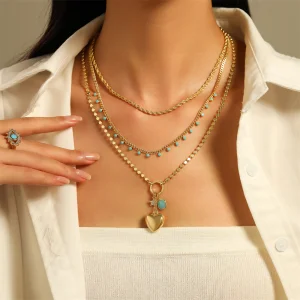
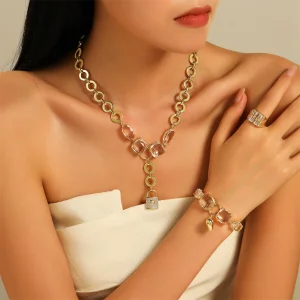
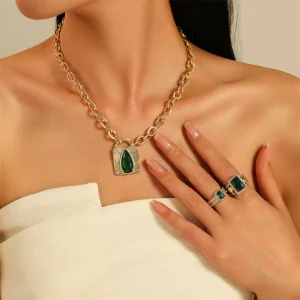
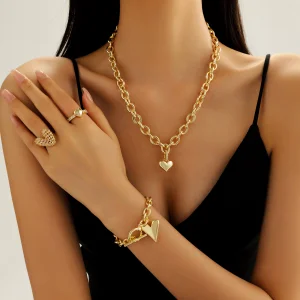
Explore custom heart charms, wheat link designs, green agate accent sets, and crystal-adorned statement pieces.