 \n
Featured Wholesale Jewelry Sets & Direct Factory Collections
Precision-engineered matching jewelry suites (necklaces, bracelets, earrings, and rings) manufactured directly from audited China factory floors with REACH & Prop 65 compliance.
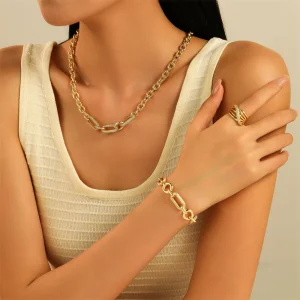
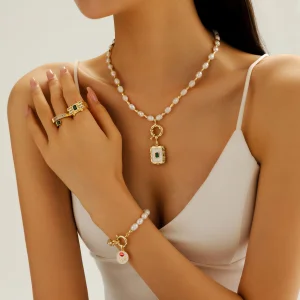
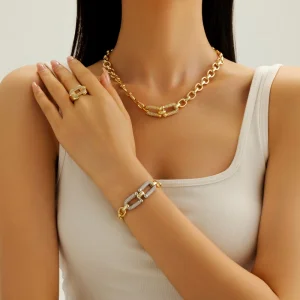
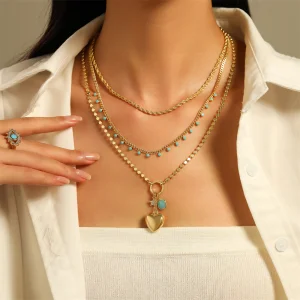
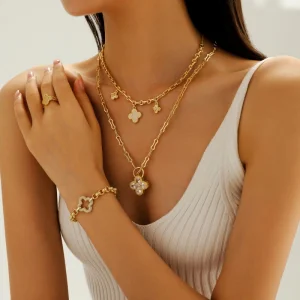
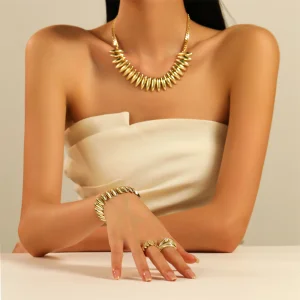
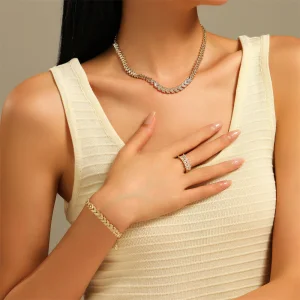
The B2B Manufacturing Architecture of Wholesale Jewelry Sets
In the hyper-competitive global retail and e-commerce ecosystem, procurement officers, brand managers, and commercial importers no longer evaluate fashion jewelry purely on aesthetic design. Success requires a sophisticated, highly integrated supply chain strategy. Sourcing Wholesale Jewelry Sets (matched multi-piece suites comprising necklaces, bracelets, earrings, and rings) provides retail brands with a massive operational advantage: achieving up to 42% higher average order value (AOV) and superior gross margins compared to single-piece merchandising.
However, producing synchronized jewelry sets introduces substantial technical challenges. A matched set demands absolute uniformity across color tone, physical luster, plating layer thickness, stone setting precision, and alloy tensile strength. A microscopic variance in gold plating hue between a pendant necklace and its companion bracelet will immediately trigger customer returns and damage brand equity. This whitepaper analyzes the manufacturing methodologies, metallurgical standards, regulatory frameworks, and supply chain logistics executed by premier Chinese OEM/ODM factories.
China's Supply Chain Ecosystem: Industrial Clusters & Technical Capabilities
China remains the undisputed epicenter of global fashion jewelry manufacturing, producing over 70% of the world's finished fashion accessories. The concentration of specialized industrial clusters in Yiwu (Zhejiang Province) and Guangzhou/Dongguan (Guangdong Province) creates an unparalleled ecosystem of raw material access, precision tooling, electroplating engineering, and export logistics.
Rapid Tooling & 3D Prototyping
Modern China jewelry factories leverage high-resolution SLA 3D resin printing and computer-aided design (CAD) to transition from a buyer's 2D concept sketch to a tactile physical prototype within 48 to 72 hours. Master steel molds are cut using multi-axis CNC machinery, drastically reducing tooling costs and accelerating sample sign-off cycles.
Advanced PVD Vacuum Ion Coating
Leading manufacturers have replaced traditional rack electroplating with environmentally clean Physical Vapor Deposition (PVD) vacuum ion plating. By bombarding 316L stainless steel or brass substrates with titanium nitride and real 18K/14K gold target materials in a vacuum chamber, factories achieve micro-coatings ranging from 0.03 μm up to 3.0 μm (vermeil standard), rendering jewelry non-tarnish and waterproof for up to 2 years of daily wear.
End-to-End Vertical Integration
From primary alloy melting and investment casting to micro-pave cubic zirconia setting, magnetic clasp assembly, laser logo engraving, and retail packaging—vertical integration minimizes third-party markups and guarantees rigorous quality control at every phase of the manufacturing line.
Metallurgical & Base Substrate Comparison Matrix
| Substrate Material | Tensile Strength & Durability | Plating Compatibility | Hypoallergenic Grade | Target Market Application |
|---|---|---|---|---|
| 316L Surgical Stainless Steel | Extreme (Waterproof, anti-scratch) | PVD Vacuum Ion Plating (18K Gold, Rose Gold, Jet Black) | 100% Nickel-Free / Medical Grade | E-commerce DTC Brands, Everyday Wear, Waterproof Lines |
| Eco-Friendly Brass Alloy | Moderate (High malleable detail) | Rack Electroplating + E-Coating / Heavy Gold Vermeil | High (Compliant with REACH & Prop 65) | High-Fashion Boutiques, Intricate Statement Sets, Fine CZ Jewelry |
| 925 Sterling Silver | Premium (Precious Metal Standard) | Rhodium Flash / 18K Yellow Gold Heavy Plating | Hypoallergenic | Fine Fashion Retailers, Premium Gift Collections |
| Zinc Alloy (Die-Cast) | Standard (Cost-effective for high volume) | Barrel/Rack Plating + Protective Lacquer | Medium (Requires certified barrier layer) | Mass Market Retail Chains, Promotional & Fast Fashion Sets |
Solving Global Enterprise Procurement Challenges
B2B buyers—ranging from high-volume department stores in North America to curated digital DTC fashion brands in Europe—face distinct procurement friction points when importing wholesale jewelry sets from overseas factories. Premier manufacturers address these challenges with strategic operational frameworks:
1. Batch Color & Tonal Matching
Problem: A multi-piece set containing a chain necklace, a heavy link bracelet, and stud earrings produced in separate plating runs often exhibits slight color variance (e.g., warmer yellow vs pale yellow gold).
Solution: Advanced factories utilize X-Ray Fluorescence (XRF) Spectrometry and spectrophotometers to lock down exact RGB color wavelengths and thickness readings for every batch, enforcing strict spectrum tolerances (ΔE < 0.8).
2. Flexible Tiered MOQs
Problem: Traditional factories demand high Minimum Order Quantities (1,000+ units per style), forcing brand managers to tie up significant working capital in unproven inventory.
Solution: Modern B2B supplier models support agile inventory strategies by offering flexible low MOQs starting at 50 to 100 sets per style for stock designs, and 200 sets for custom OEM tools, enabling rapid market testing.
3. Private Label & Turnkey Packaging
Problem: Receiving bulk un-packaged product requires buyers to incur expensive local labor costs for bagging, tagging, barcoding, and boxing.
Solution: OEM factories deliver complete turnkey packaging—custom rigid presentation boxes, velvet pouches, anti-tarnish tissue inserts, branded care cards, UPC/EAN barcode labels, and FBA prep compliance straight from China.
Localized Market Application Scenarios & Consumer Preferences
Consumer taste profiles for jewelry sets vary significantly across global geographic territories. Custom jewelry manufacturers engineer collections targeted specifically toward regional aesthetic preferences, ergonomic sizing, and cultural buying behaviors.
North America (USA & Canada)
Aesthetic Profile: High demand for bold statement pieces, heavy paperclip link chains, chunky lockets, stackable multi-layer necklaces, and waterproof stainless steel jewelry. 18K yellow gold vacuum PVD plating dominates consumer search intent.
Regulatory Focus: California Proposition 65 compliance (strict lead and cadmium limits) and CPSIA testing for fashion jewelry targeting youth demographics.
Europe (EU & UK)
Aesthetic Profile: Preference leans toward understated elegance, French romanticism, vintage baroque freshwater pearls, delicate filigree work, and minimalist geometric shapes. Warmer 14K gold tones and anti-tarnish rhodium finishes are top sellers.
Regulatory Focus: Strict enforcement of EU REACH Annex XVII (Entry 27 Nickel Release rate below 0.5 μg/cm²/week) and zero-cadmium thresholds.
Latin America & Middle East
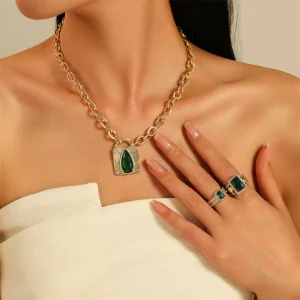
Aesthetic Profile: Strong preference for high-luster 24K and 18K deep yellow gold finishes, expansive multi-piece suites (Necklace + Bracelet + Earrings + Ring), intricate stone pave setting with AAA cubic zirconia or synthetic agate accents.
Regulatory Focus: High durability coatings designed to withstand humid climatic conditions without tarnishing or peeling.
International Chemical Compliance & Quality Control Protocols
Product compliance is a non-negotiable prerequisite for enterprise B2B sales. Leading jewelry factories implement rigorous internal testing regimes alongside third-party certification (SGS, Bureau Veritas, TÜV Rheinland) to protect buyers against customs detentions and market compliance actions.
Chemical & Heavy Metal Regulations
- REACH Annex XVII: Verifies nickel release rates remain under 0.5 μg/cm²/week for direct skin-contact items, and under 0.2 μg/cm²/week for post assemblies.
- California Proposition 65: Mandates total lead content under 90 ppm and total cadmium content under 75 ppm.
- ASTM F2923 / CPSC: Standard specification for consumer product safety for children's and adult jewelry accessories.
Physical & Reliability Testing Gates
- Salt Spray Corrosion Testing: Exposing plated samples to 5% salt spray fog at 35°C for 24 to 72 hours to simulate years of sweat and humidity exposure.
- Cross-Hatch Adhesion Test: Assessing plating layer bonding to guarantee zero peeling or flaking under physical strain.
- Clasp Fatigue Testing: Lobster clasps and OT toggles undergo 5,000+ automated open/close cycles to ensure spring retention.
Industry Development Trends: Sustainability & AI Integration
The wholesale jewelry set manufacturing sector is undergoing rapid technological transformation. Forward-thinking China factories are adopting digital innovations and sustainable manufacturing principles to stay ahead of global buyer demands:
AI-Powered Generative CAD & Trend Forecasting
By analyzing social media trend data, search volume metrics, and historical sales patterns, factory R&D teams use generative AI tools to output dozens of optimized 3D CAD renders weekly. This reduces design turnaround times from weeks to hours.
Eco-Friendly Metals & Closed-Loop Plating
Environmental responsibility is reshaping modern factories. Leading facilities utilize 100% recycled 316L stainless steel and eco-brass, alongside zero-discharge water filtration systems in PVD coating operations to minimize ecological footprints.
Lab-Grown Gemstones & Synthetic Agates
Replacing mined gemstones with high-clarity lab-grown cubic zirconia, synthetic emeralds, and ethically cultivated shell pearls allows factories to supply opulent jewelry sets at a fraction of fine jewelry costs.
Frequently Asked Questions (FAQ) for B2B Procurement Officers
Direct technical answers to common questions asked during factory audits, sampling procedures, and purchase order negotiations.
What is the baseline Minimum Order Quantity (MOQ) for OEM/ODM jewelry set orders?
How long does the production process take from initial design sketch to export shipment?
- Sampling Phase: 2D CAD renderings are produced in 24-48 hours. 3D resin prints and polished physical prototypes take 7 to 10 working days.
- Mass Production Phase: Standard bulk manufacturing takes 15 to 25 calendar days, depending on order volume and plating specifications.
What chemical test reports and compliance certificates do you provide?
How do you ensure zero color variation across different components of a jewelry set?
Can the factory accommodate private label branding and FBA packaging requirements?
What shipping terms (Incoterms) and payment methods are supported?
Explore Additional Factory Direct Wholesale Jewelry Collections
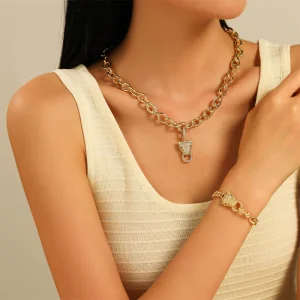
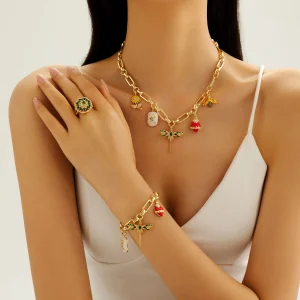
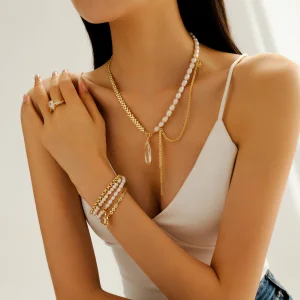
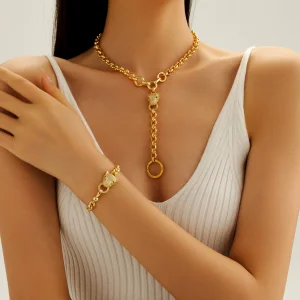
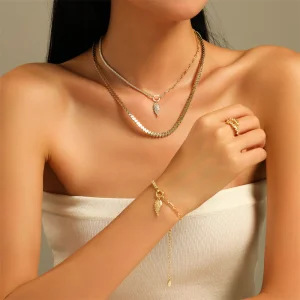
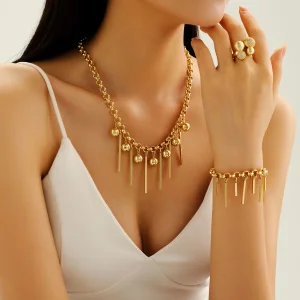
Expand your brand catalog with our high-margin, market-tested fashion jewelry sets and individual trending styles.
Request Factory Direct Quotations & Product Catalogs
Partner with a verified China jewelry manufacturer. Submit your tech pack, design sketch, or target specs to receive line-item OEM pricing, AQL quality guarantees, and sample production within 24 hours.
Contact Engineering & B2B Sales