 \n
High-Precision Necklace Sets Engineered for the European Market
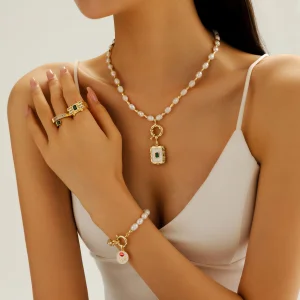
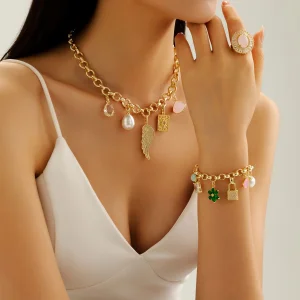
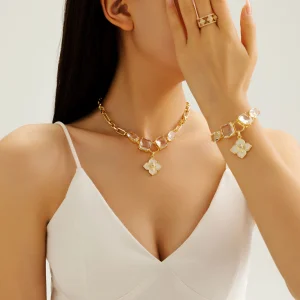
Featured 4-item production series configured with anti-tarnish PVD gold coating, hypoallergenic nickel-free compliance (EN 1811), and custom laser-engraved branding.

The German Jewellery Landscape & Global Sourcing Imperatives
Understanding market dynamics, consumer expectations for durability, and regulatory friction points across Central Europe.
The German Jewellery Market: Quality Precision & Supply Chain Shift
Germany represents one of Europe's largest and most discerning consumer markets for fashion and semi-fine jewelry. Historically anchored by traditional goldsmithing hubs like Pforzheim (the "Goldstadt"), the contemporary German landscape has evolved dramatically. Today, direct-to-consumer (DTC) brands in Berlin, omnichannel department stores in Hamburg, luxury boutique networks in Munich, and high-volume e-commerce distributors in Frankfurt demand a fusion of rapid design agility and industrial-grade manufacturing standards.
German consumers prioritize product lifespan, material safety, and structural integrity. A necklace sold in Germany is expected to withstand daily wear, contact with perfumes and moisture, and extended exposure without tarnishing or triggering skin irritation. Consequently, necklace factories serving Germany cannot rely on legacy standard electroplating. They must deploy advanced material sciences such as 316L surgical stainless steel substrates and PVD (Physical Vapor Deposition) titanium ion coating.
Global Necklace Manufacturing Dynamics
Globally, the fashion necklace sector is undergoing a technology-driven consolidation. Precision CNC machining, 3D wax micro-printing, and automated laser soldering have replaced purely manual assembly lines. This modernization enables overseas OEM/ODM manufacturing hubs in Yiwu and Guangdong to produce retail-ready jewelry matching European artisan standards at scalable price points.
By establishing streamlined direct-factory corridors between specialized manufacturing units and German import houses, brands eliminate multi-tiered intermediary markups while retaining full control over custom design specifications, metal purity, and batch-level quality assurance (QA).
Engineering Excellence & Compliance Framework for Germany
A rigorous analysis of substrate selection, surface finishing technology, and European regulatory compliance protocols.
REACH Annex XVII Compliance
Full conformance with Regulation (EC) No 1907/2006. Rigorous laboratory verification guaranteeing Lead (< 0.05%), Cadmium (< 0.01%), and Nickel release rate below 0.5 μg/cm²/week under EN 1811 standard testing.
PVD Vacuum Ion Plating
Utilizing high-energy Titanium Nitride (TiN) physical vapor deposition combined with real 18K Real Gold target sputtering. Achieves 10x higher wear resistance compared to standard flash water electroplating.
Substrate Alloy Engineering
Premium 316L Surgical Stainless Steel and H65 Eco-Friendly Solid Brass base matrices. High corrosion resistance against salt spray, sweat acidity, and atmospheric oxidation common in Northern European climates.
| Manufacturing Parameter | Standard Export Grade | German Market Spec (Fully Design Standard) | Testing & Verification Method |
|---|---|---|---|
| Base Metal Substrate | Recycled Zinc Alloy / 304 Steel | Medical Grade 316L Stainless Steel / H65 Brass | X-Ray Fluorescence (XRF) Spectrometry |
| Gold Plating Tech | Water Electroplating (0.01-0.02μm) | Vacuum PVD Titanium Ion Sputtering (0.03-0.1μm) | X-Ray Plating Thickness Gauge |
| Tarnish Resistance | 4 - 8 Hours Salt Spray | 24 - 48 Hours Neutral Salt Spray (NSS Test) | ISO 9227 Corrosion Testing |
| Nickel Release Rate | < 1.5 μg/cm²/week | < 0.2 μg/cm²/week (Passes EN 1811:2011+A1:2015) | Atomic Absorption Spectroscopy (AAS) |
| Quality Control Level | AQL 4.0 General Inspection | AQL 2.5 Strict Double Sampling (100% Visual Inspection) | DIN ISO 2859-1 Standards |
Localized Application Scenarios Across German Commercial Hubs
Custom tailored factory solutions for distinct retail channels, regional demands, and logistics corridors in Germany.
E-Commerce & Amazon FBA Sellers (Hamburg & North Rhine-Westphalia)
Specialized packaging workflows including scannable EAN/UPC barcoding, polybagging, anti-tarnish velvet pouch insert, and direct shipments to German FBA fulfillment centers (e.g., DTM1, EDB4) via DDP sea/air freight.
Boutique Fashion Chains (Munich, Stuttgart & Bavaria)
Curated capsule collections featuring niche retro designs, baroque pearls, and semi-precious stone accents. Low MOQ per style flexibility (50-100 pcs) allows boutique buyers to refresh seasonal inventory without over-leveraging capital.
Private Label Streetwear Brands (Berlin & Leipzig)
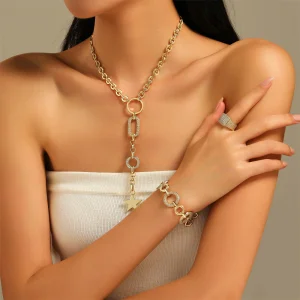
Bold, heavy-link chunky chains, Y-shaped toggle clasps, and unisex minimalist geometry. Custom mold development from 2D vector files with rapid 7-day 3D wax sampling for fast fashion drop cycles.
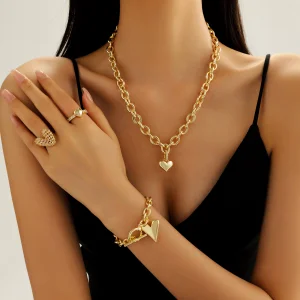
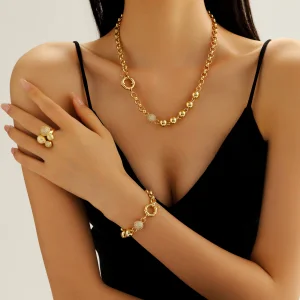
Expanded OEM/ODM Custom Necklace & Jewelry Lineup
Explore our full range of custom-manufactured necklace sets, pendants, and chain styles ready for private label production.
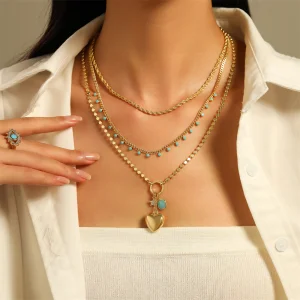
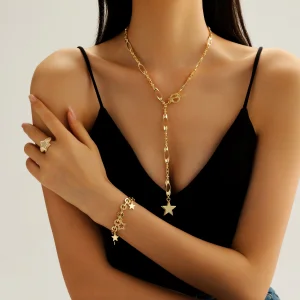
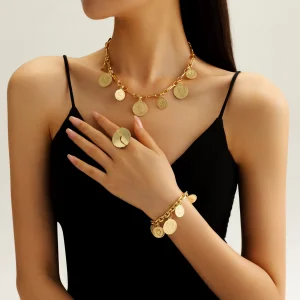
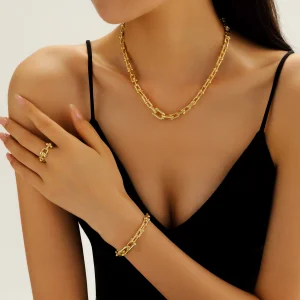

Frequently Asked Questions for German Import Procurement
Addressing compliance certification, customs logistics, technical standards, and OEM customization requirements.
How do your necklace factories ensure compliance with EU REACH Regulation Annex XVII & EN 1811?
We maintain strict raw material control before casting or machining begins. All batch lots of 316L stainless steel and H65 brass are tested via X-ray Fluorescence (XRF) spectrometry for heavy metal contamination. Finished pieces undergo third-party laboratory verification (SGS/TÜV/BV) confirming that Nickel release rates remain strictly below 0.2 μg/cm²/week, fully satisfying DIN EN 1811:2011+A1:2015 standards for prolonged skin contact.
What is the difference between PVD Titanium Ion Plating and standard Electroplating for German retail?
Standard flash electroplating deposits a thin layer of gold (0.01-0.02 μm) over a copper/nickel base, which oxidizes rapidly when exposed to humidity or sweat. Our factory utilizes Physical Vapor Deposition (PVD) in a high-vacuum chamber. Titanium ions combined with 18K real gold are vaporized and deposited onto 316L stainless steel. This creates a molecular bond reaching 0.03 to 0.1 μm thickness, enduring 24-48 hours of neutral salt spray (NSS) testing and resisting wear for 1-3 years of daily wear.
What logistical terms (Incoterms) do you support for direct shipping to German locations?
We support standard FOB (Ningbo/Shanghai), EXW, and comprehensive DDP (Delivered Duty Paid) air and ocean shipping directly to your German warehouse or Amazon FBA fulfillment center. Under DDP terms, our logistics partners clear German customs (Zoll), handle import VAT (Eust / Einfuhrumsatzsteuer), and manage duty payments so your goods arrive shelf-ready without tax paperwork delays.
Can you provide custom logo laser engraving and private label German packaging?
Yes. Our automated fiber-laser engravers execute microscopic brand logos, hallmark stamps (e.g., "S.Steel", "18K PVD"), and batch serial numbers on clasps or custom tags. Furthermore, we produce FSC-certified eco-friendly paper packaging, velvet drawstring pouches, and barcode labels compliant with German packaging law (VerpackG / LUCID system registration).
What is the typical sampling and bulk production timeline for a custom necklace order?
CAD rendering takes 24 to 48 hours following your sketch or reference concept. 3D wax micro-printing and physical counter-sampling take 7 to 10 working days. Once the sample is approved by your QA team, mass production typically requires 15 to 20 calendar days depending on batch volume and stone setting complexity.
Partner with a Certified Necklace Factory Serving Germany
Streamline your B2B supply chain with REACH-compliant materials, anti-tarnish PVD coating, and direct factory pricing. Request full technical datasheets, sample packs, or custom quotes within 24 hours.
Send Inquiry Now